Table of contents
Kitchener-Waterloo vs. GTA Rental Prices: What Renters Are Paying in 2026
If you’ve been priced out of the Greater Toronto Area rental market — or you’re simply weighing where to plant roots next — the numbers make a compelling case for Kitchener-Waterloo. As of 2026, KW renters are paying meaningfully less than their GTA counterparts across every unit size. Furthermore, the gap holds up even as both markets shift under new supply and changing demand. It’s worth highlighting that rental prices are shaping the decisions of many in both regions.
Here’s what the data actually shows about overall rental prices this year.
The Headline Numbers
| Unit Size | K-W Average | GTA Average | K-W Savings |
|---|---|---|---|
| 1 Bedroom | $1,820/mo | $2,007/mo | ~9% cheaper |
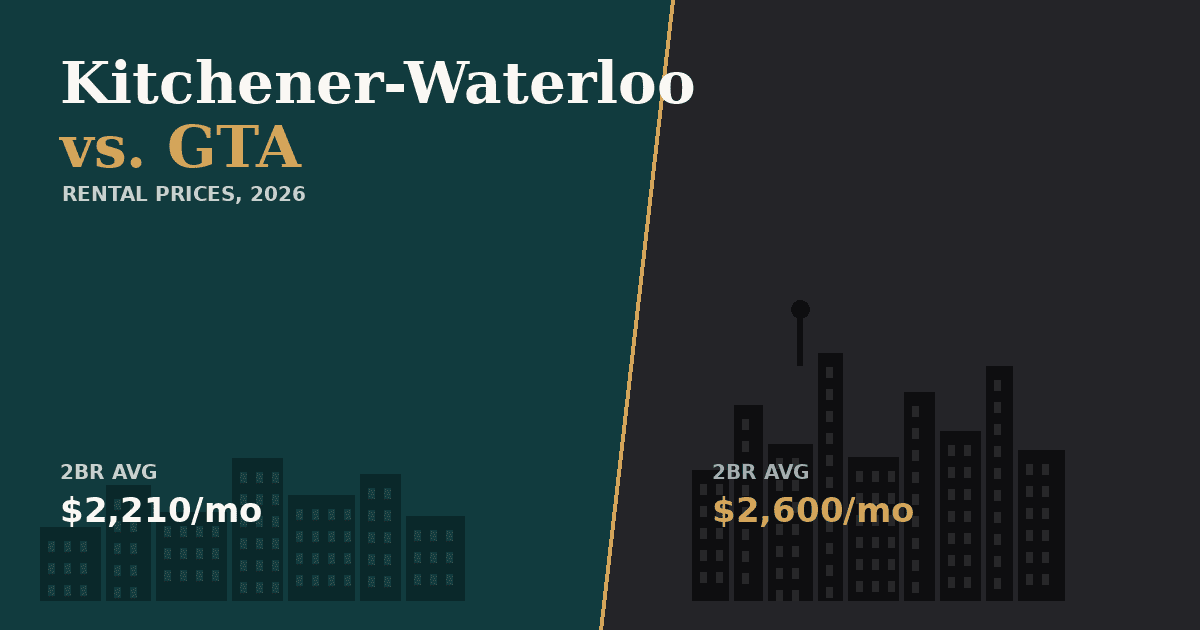
| 2 Bedroom | $2,210/mo | $2,600/mo | ~15% cheaper |
| 3 Bedroom | $2,680/mo | $3,053/mo | ~12% cheaper |
Figures are drawn from CMHC Rental Market Survey data, D&D Property Management, liv.rent’s Ontario Rent Report, Zumper, and TRREB, reflecting data as of April–August 2026. Rental markets shift quickly and methodologies vary by source, so treat these numbers as directional rather than exact — readers should verify current rates with the original sources or a local rental professional before making financial decisions.
Across the board, KW comes in hundreds of dollars cheaper per month — savings that add up to $4,500 to $7,500 a year depending on unit size. Naturally, these rental prices make a significant impact on annual budgets.
The Two-Bedroom Breakdown
Two-bedroom units — the workhorse of the rental market for couples, roommates, and small families — show the clearest picture of the KW discount.
| City / Region | 2BR Average Rent |
|---|---|
| Kitchener | $1,970/mo |
| Waterloo | $2,000/mo |
| KW CMA (blended) | $2,210/mo |
| Mississauga | $2,510/mo |
| Markham | $2,600/mo |
| GTA Overall | $2,600/mo |
Kitchener sits at the floor of the regional range. Even Waterloo — pricier than Kitchener thanks to its proximity to the universities and the Uptown core — still lands well under every GTA comparison point. The gap between a Kitchener two-bedroom and the GTA average works out to roughly $630/month, or about $7,500 a year. When you look strictly at rental prices for these units, the difference is clear.
Why the Gap Exists — and Why It’s Holding
The GTA is oversupplied right now. A wave of condo completions has pushed GTA one-bedroom rents down 12.5% year-over-year as of April 2026. Two-bedrooms have fallen 8.2% over the same period — the steepest two-bedroom decline of any Ontario market tracked by liv.rent. Landlords across Toronto, Markham, and North York are competing hard for tenants. In turn, this affects rental prices throughout the region.
KW’s market is tighter. The Kitchener-Cambridge-Waterloo CMA vacancy rate sits around 2.1%, below the 3% mark generally considered a “balanced” market. New-lease rent growth is still running about 5.4% year-over-year — roughly double the province’s rent-increase guideline for existing tenants. So while KW is cheaper, it isn’t loosening the way the GTA currently is. Rental prices remain competitive despite the higher demand.
Not all of the GTA is equally expensive. Downtown Toronto, Oakville, and Burlington sit well above $2,000 for a one-bedroom, while Brampton ($1,779) and Oshawa ($1,603) rank among the most affordable municipalities in the region. If you’re comparing KW specifically to the GTA’s outer, more affordable pockets, the gap narrows. However, KW still tends to come out ahead, especially when rental prices are considered, and without the commute.
The Bigger Picture
Rent is only one line item, but it’s usually the biggest one. Factoring in the broader cost of living, Kitchener-Waterloo runs approximately 24% cheaper than Toronto on rent alone. There are also comparable savings on car insurance (about 15-25% lower) and modest savings on groceries and transit. Add it up, and a typical household can save over $26,000 a year moving from Toronto to KW. Often, rental prices are what tip the scales for those making a relocation decision.
The Takeaway
For renters weighing a move, the math is straightforward: KW offers meaningfully lower rent across every unit size, a shorter commute into a growing tech and university hub, and a cost of living that stretches further overall. The trade-off is a tighter rental market with less negotiating power than what GTA renters currently enjoy. Therefore, if you’re planning a move to Kitchener-Waterloo, it pays to move decisively once you find the right unit. In summary, keeping a close eye on rental prices could help you secure a better deal when you act quickly.
Thinking about a move to Kitchener-Waterloo, or want a clearer picture of what your budget gets you here versus the GTA? Contact us — we’re happy to walk you through the neighbourhoods and numbers.
Figures are drawn from CMHC Rental Market Survey data, D&D Property Management, liv.rent’s Ontario Rent Report, Zumper, and TRREB, reflecting data as of April–August 2026. Rental markets shift quickly and methodologies vary by source, so treat these numbers as directional rather than exact — readers should verify current rates with the original sources or a local rental professional before making financial decisions.